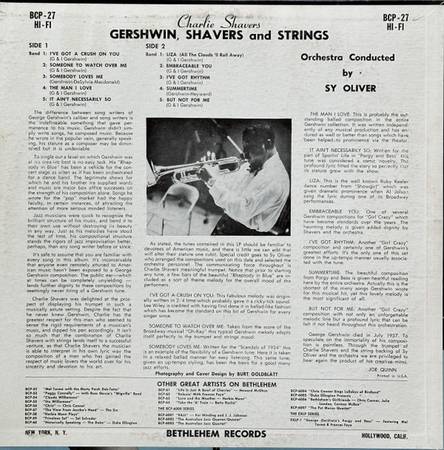
The difference between song writers of
George Gershwin's caliber and song writers is the indefineable something that gave permanence to his music. Gershwin didn't simply write songs, he composed music. Because he wrote in the popular vein, generally speaking, his stature as a composer may be diminished but it is undeniable.
To single out a level on which Gershwin was
at his creative best is no easy task. His "Rhapsody in Blue" has been a vehicle for the concert stage as often as it has been orchestrated
for a dance band. The legitimate shows for
which he and his brother Ira supplied words
and music are major box office successes on
the strength of his composition alone. Songs he
wrote for the "pop" market had the happy
faculty, in certain instances, of attracting the
attention of more serious minded listeners.
Jazz musicians were quick to recognize the
brilliant structure of his music, and bend it to
their own use without destroying its beauty
in any way. Just as his melodies have stood
the test of time, his compositional structure
stands the rigors of jazz improvisation better,
perhaps, than any song writer before or since.
It's safe to assume that you are familiar with
every song in this album. It's inconceivable
that anyone even remotely attuned to American music hasn't been exposed to a George
Gershwin composition. The public ear — which
at times can be completely unyielding —
lends further dignity to these compositions by
seemingly never tiring of a Gershwin tune.
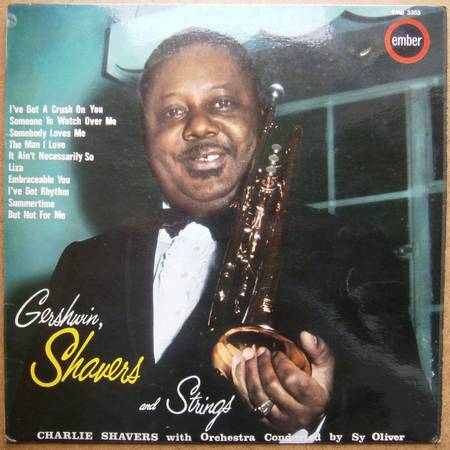
Charlie Shavers was delighted at the prospect of displaying his trumpet in such a musically astute setting. Despite the fact that he never knew Gershwin, Charlie has the greatest respect for this man who seemed to sense the rigid requirements of a musician's music, and dipped his pen accordingly. It isn't so much that the combination of Charlie
Shavers with strings lends itself to a successful
venture, as that Charlie Shavers the musician
is able to interpret in his own lyric way the
composition of a man who has gained the
respect of music lovers the world over for his
sincerity and devotion to his art.
As stated, the tunes contained in this LP should be familiar to devotees of American music, and there is little we can add that will alter their stature one cubit. Special credit goes to Sy Oliver who arranged the compositions used on this date and selected the orchestra personnel. The communicating force throughout is Charlie Shavers meaningful trumpet. Notice that prior to starting any tune, a few bars of the beautiful "Rhapsody in Blue" are included as a sort of theme melody for the overall mood of the
performers.
I'VE GOT A CRUSH ON YOU: This fabulous melody was originally written in 2/4 time which probably gave it a ricky-tick sound. Lee Wiley is credited with having first done it in ballad-like fashion which has become the standard on this bit of Gershwin for every singer since.
SOMEONE TO WATCH OVER ME: Taken from the score of the Broadway musical "Oh-Kay" this typical Gershwin melody adapts itself perfectly to the trumpet and strings mood.
SOMEBODY LOVES ME: Written for the "Scandals of 1924" this is an example of the flexibility of a Gershwin tune. Here it is taken in a relaxed ballad manner for easy listening. This same tune,
given an up-tempo styling, has been the basis for a good many jazz efforts.
THE MAN I LOVE: This is probably the outstanding ballad composition in the entire Gershwin collection. It was written indepently of any musical production and has endured as well or better than songs which have been helped to prominence via the theater.
IT AIN'T NECESSARILY SO: Written for the
part of Sportin' Life in "Porgy and Bess" this
tune was considered a comic novelty. The
profound lyric fitted the story so perfectly that
its stature grew with the show.
LIZA: This is the well known Ruby Keeler
dance number from "Showgirl" which was
given dramatic prominence when Al Jolson
sang the lyric during one of its Broadway
performances.
EMBRACEABLE YOU: One of several
Gershwin compositions for "Girl Crazy" which
have become standards over the years. The
haunting melody is given added dignity by
Shavers and the orchestra.
I'VE GOT RHYTHM: Another "Girl Crazy"
composition and certainly one of Gershwin's
greatest efforts. It's the only one of this set done in the up-tempo manner usually associated with the tune.
SUMMERTIME: The beautiful composition from Porgy and Bess is given heartful reading here by the entire orchestra. Actually this is the shortest of the many songs Gershwin wrote for this musical hit, yet this lovely melody is the most significant of all.
BUT NOT FOR ME: Another "Girl Crazy"
composition with not only an unforgettable melodic line but a profound lyric that can be felt if not heard throughout this orchestration.
George Gershwin died in July 1937. To
speculate on the immortality of his composition is pointless. Through the trumpet of Charlie Shavers and the string backing of Sy Oliver and the orchestra we are privileged to hear again the product of his creative mind.
-- JOE QUINN.
(album notes)
-------
Charles James Shavers (August 3, 1920 – July 8, 1971). was an American jazz trumpeter who played with Dizzy Gillespie, Nat King Cole, Roy Eldridge, Johnny Dodds, Jimmie Noone, Sidney Bechet, Midge Williams, Tommy Dorsey, and Billie Holiday. He was also an arranger and composer, and one of his compositions, "Undecided", is a jazz standard.
Shavers's father, a distant relative of Fats Navarro, was from the Shavers family of Key West, Florida. Charlie Shavers was a cousin of heavyweight boxer Earnie Shavers. Born in New York City, he took up piano and banjo before switching to trumpet. In the mid-1930s, he performed with Tiny Bradshaw and Lucky Millinder. In 1935, he played in the trumpet section with Dizzy Gillespie and Carl (Bama) Warwick in Frankie Fairfax's Campus Club Orchestra. In 1936, he joined John Kirby's Sextet as trumpet soloist and arranger. He was only 16, but gave his birth date as 1917 to avoid child labor laws; many biographies still list this date.
Shavers's arrangements and solos helped make the band one of the most commercially successful and imitated of its day. In 1937, he performed with Midge Williams and her Jazz Jesters. In 1944, he began playing sessions in Raymond Scott's CBS staff orchestra. In 1945, he left John Kirby's band to join Tommy Dorsey's Orchestra, with whom he toured and recorded, off and on, until Dorsey's death in 1956. In 1949, he sang and played the hit "The Hucklebuck" with the Dorsey Orchestra.[6] He can be seen as a member of Dorsey's Orchestra on numerous "Stage Show" telecasts for CBS, including early Elvis Presley appearances. During this time he also continued to play at CBS; he also appeared with the Metronome All-Stars, and made a number of recordings as trumpet soloist with Billie Holiday. From 1953 to 1954, he worked with Benny Goodman and toured Europe with Norman Granz's popular Jazz at the Philharmonic series. He formed his own band with Terry Gibbs and Louie Bellson. ...
-- Wikipedia
-----/